When a maintenance technician orders M12 bolts to replace existing fasteners, it is natural to assume that an M12 is an M12. But DIN- and ISO-standardized bolts with the same thread diameter can have different head geometries: which in practice gives different wrench sizes. An M12 hexagon bolt to DIN 931 requires wrench size SW 19, while the equivalent bolt to ISO 4014 requires SW 18. If the wrong standard is ordered, the tool does not fit. In oil and gas, offshore and heavy industry, despite the small difference, this can lead to installation delays, incorrect torque application and weakened joint integrity. Correct technical specification of the standard is not a formality. It is a prerequisite for safe installation.
Reference table: SW sizes DIN vs ISO for M8–M24
The table below shows the wrench size (SW) for the most common dimensions according to DIN 931/933 and ISO 4014/4017 respectively. The deviations are directly operationally relevant for maintenance teams with a fixed tool set-up.
|
Diameter |
DIN 931/933 SW |
ISO 4014/4017 SW |
Deviation |
|
M8 |
13 mm |
13 mm |
None |
|
M10 |
17 mm |
16 mm |
1 mm (different wrenches) |
|
M12 |
19 mm |
18 mm |
1 mm (different wrenches) |
|
M14 |
22 mm |
21 mm |
1 mm (different wrenches) |
|
M16 |
24 mm |
24 mm |
None |
|
M18 |
27 mm |
27 mm |
None |
|
M20 |
30 mm |
30 mm |
None |
|
M22 |
32 mm |
32 mm |
None |
M24 |
36 mm |
36 mm |
None |
What is the industrial problem?
DIN 931 and ISO 4014 both describe partially threaded hexagon bolts for metric use, but they are not dimensionally identical at every point. The DIN standard consistently specifies a larger wrench size than the ISO equivalent for the diameters M10 and M12. For M10, DIN 931 specifies SW 17, while ISO 4014 specifies SW 16. The same applies to nuts: DIN 934 and ISO 4032 are not identical. An M12 DIN 934 nut requires SW 19, while ISO 4032 requires SW 18.
A maintenance team with DIN-calibrated tools cannot simply work on ISO-standardized joints, and vice versa. In planned maintenance this is manageable. During unplanned downtime on a compressor or a flange system it is an operational interruption with a direct cost. Older plants in Norwegian heavy industry are typically built with DIN-standardized fasteners, while newer OEM equipment from European and Asian manufacturers follows ISO specifications. On many installations both standards exist side by side.
How does the difference between standards affect joint integrity?
The consequence of the wrong standard is not only a practical problem with tools. It can directly affect the bolt torque achieved at installation. A wrench that does not fit the head geometry precisely increases the risk of the head faces rounding off and of reduced torque transfer. This gives a lower preload than the technical specification requires.
In vibration-exposed systems such as rotating machinery, pump foundations and compressor housings, correct preload is a design prerequisite. Even small deviations from the specified preload accelerate preload loss under dynamic loading. Over time this leads to progressive failure of joint integrity without the fault being visible on visual inspection.
Why do standard locking methods fail under vibration?
When the correct bolt torque cannot be guaranteed at installation: because the tool set is not optimally matched to the bolt head: the risk increases that the joint will lose preload during operation. Standard spring washers and nylon lock nuts depend on friction to maintain clamping force. Friction is progressively reduced under dynamic loading, settling and thermal cycling. When the initial preload is lower than specified, this process is accelerated considerably.
Flange systems in process plants, compressor housings and turbine mountings are applications where preload loss under vibration has direct consequences for system integrity. Standard spring washers do not maintain a defined clamping force over time in these environments.
Why are NORD-LOCK washers necessary?
NORD-LOCK wedge-locking washers are designed to maintain the clamping force mechanically, regardless of whether the initial preload is exactly as specified. The wedge-locking principle uses wedge-shaped undersides which, under load, force the washers to increase the clamping force rather than give way. This actively counteracts rotation under vibration and dynamic loading, without depending on friction in the thread surfaces.
In installations where mixtures of DIN and ISO standards occur and the tooling situation is not always ideal, NORD-LOCK washers give an extra level of safety for joint integrity. They are particularly relevant in offshore installations, rotating machinery and process flanges where documented preload retention is a requirement. INDUSTRISALG holds a wide range of NORD-LOCK wedge washers in stock.
Correct procurement procedure and sorting regime
The correct procedure when purchasing replacement bolts: identify the existing standard by measuring the actual wrench size with calibrated measuring equipment. Do not assume on the basis of diameter alone. Then specify the purchase order with a full technical specification, for example: M12 x 1.75, ISO 4014, strength class 8.8, hot-dip galvanized to ISO 10684.
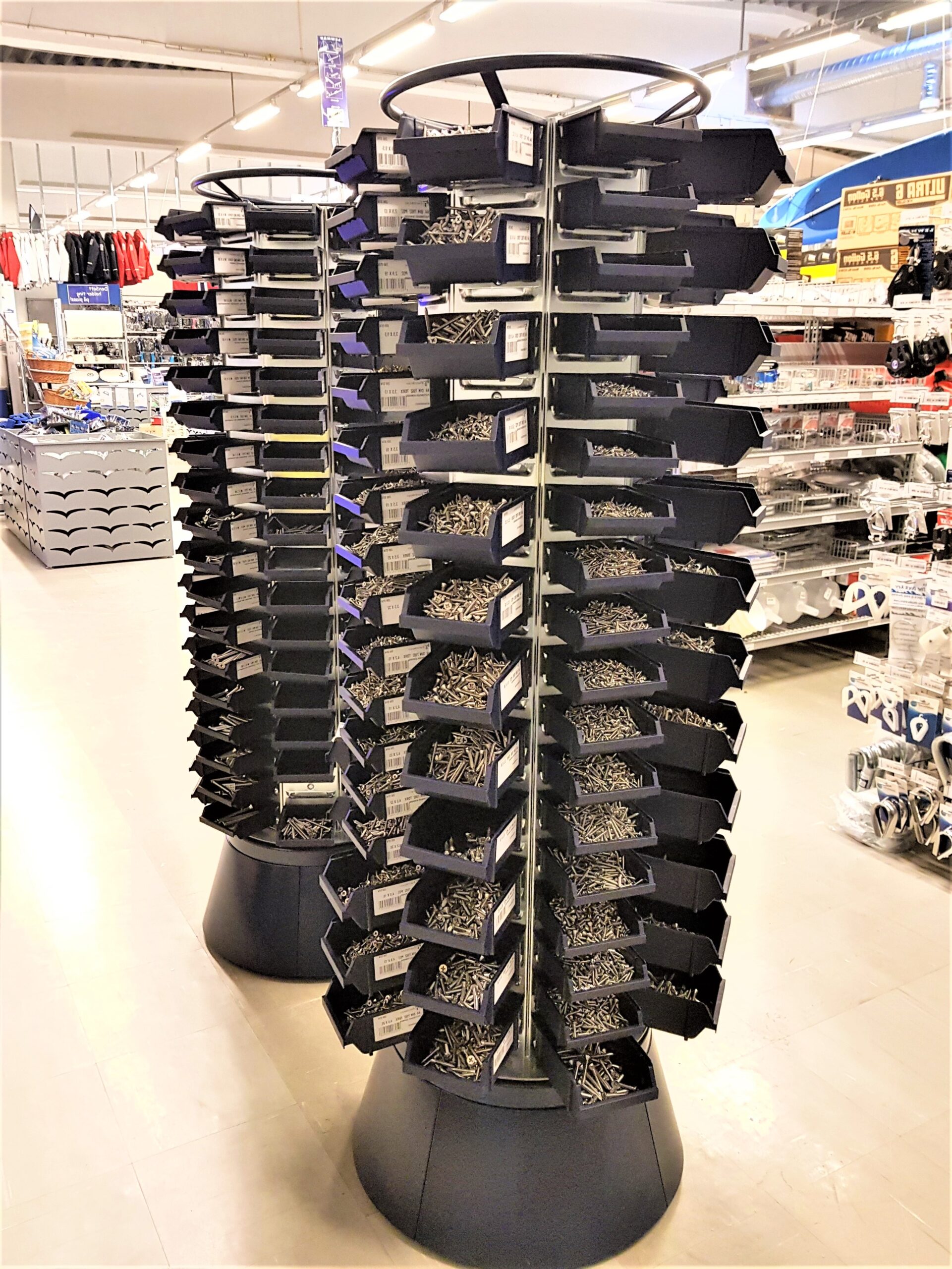
Where installations contain a mixture of DIN and ISO, establish a documented inventory with clearly labelled bins per standard. Mixing DIN 931 and ISO 4014 bolts in the same bin is a source of incorrect installation. The procedure for emergency orders during downtime must contain the same minimum requirements for standard specification as ordinary purchasing.
CHECKLIST: BEFORE YOU ORDER
- Has the applicable standard at the existing connection points been verified with calibrated measuring equipment?
- Is the purchase order specified with the standard (DIN/ISO), strength class and surface treatment: not just the diameter?
- Has a storage and labelling regime been established that separates DIN and ISO variants?
- Have the torque values in the maintenance documentation been checked against the relevant standard and strength class?
Conclusion
DIN and ISO are both technically reliable standards within their own specifications. The problem arises when they are mixed without documented control. The wrong wrench size gives the wrong torque. The wrong torque gives insufficient preload. Insufficient preload gives joint failure during operation. Correct technical specification from the first order, and an ISO 9001 certified supplier, are the two prerequisites that prevent this chain of failure.
RELATED READING
- Thread types 101: machine threads, thread-forming, thread-cutting and wood screws — complete guide
- Metric vs Imperial: UNC/UNF and where it is still used in industry
Get in touch
Send us the specification with the standard (DIN/ISO), strength class and surface treatment — and we will confirm stock status and the correct wrench size for your application. INDUSTRISALG stocks DIN 931/933 and ISO 4014/4017 in the most common dimensions from M3 to M48. We supply offshore, energy and heavy industry with documentation as standard — including on rush orders.